

Autonomous Vehicles in the UAE
Why this is about much more than Robotaxis
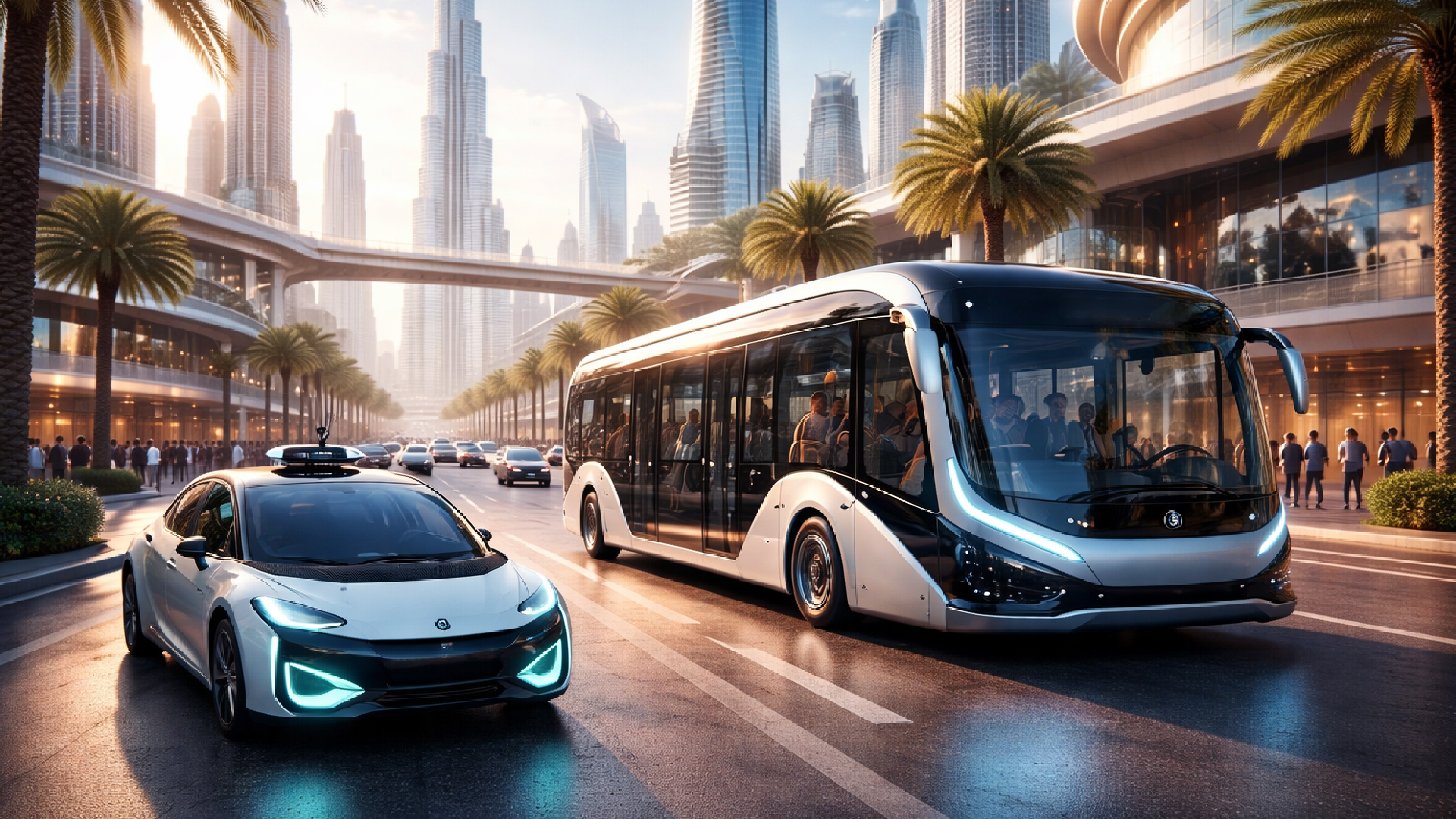
For a long time, autonomous vehicles in the Gulf sat in the familiar category of “future mobility”: impressive, attention-grabbing, but still one step removed from the mainstream transport system.
What is happening now in the UAE is not just a series of AV pilots. It is the early formation of a new transport architecture, in which autonomous taxis, driverless shuttles, metro, national rail, air taxis, underground loops and new guideway-based systems are being positioned as different layers of one wider mobility stack.
That is what makes the UAE particularly interesting. The story is not simply that it wants to “be innovative.” Many cities say that. The more important point is that different emirates are beginning to define specific roles for different emerging modes. Abu Dhabi is the clearest example of operational AV deployment. Dubai is building a regulatory and physical environment for scale. Ras Al Khaimah is using a smaller, tourism-oriented geography to test future mobility in a more controlled setting.
Abu Dhabi: The Early Mover
In March 2025, Abu Dhabi Mobility said autonomous vehicle services had already completed around 30,000 trips and set out a broader ambition for autonomous vehicles to account for 25% of all trips in the emirate by 2040. That matters because it shifts AVs out of the realm of one-off trials and places them inside a long-term transport strategy.
Abu Dhabi’s approach is also notable because it is not built around a single operator. Its autonomous mobility platform lists multiple active services and pilots, including TXAI, WeRide and AutoGo, and frames them within a centralized operational and regulatory system. The message is clear: Abu Dhabi is trying to create an ecosystem, not just stage a showcase.
That ecosystem is now moving into fully driverless territory. In November 2025, Abu Dhabi Mobility announced that the emirate had begun commercial operation of fully autonomous vehicles, granting permits to WeRide, working with Uber and Tawasul, and to AutoGo–K2 in collaboration with ApolloGo–Baidu. The same announcement said WeRide had accumulated over 800,000 autonomous kilometres in Abu Dhabi and was already operating the region’s largest commercial robotaxi network across about 50% of Abu Dhabi’s core area.
The significance of this is hard to overstate. Abu Dhabi is not just talking about the future of AVs; it is building public familiarity with real services, real passengers and real regulated operations. That is a different level of maturity from a demo route or a proof-of-concept pilot. It is the point at which autonomous mobility begins to behave like transport policy rather than innovation theatre.
Dubai: From Strategy to System Design
Dubai’s AV story has always been more visible at the strategy level. Its long-running ambition to make 25% of trips autonomous by 2030 is well known. What is more important now is that Dubai is starting to build the machinery to make that target credible. At the Dubai World Congress for Self-Driving Transport in September 2025, officials reviewed a broader Dubai Self-Driving Transport Strategy 2025–2040, with autonomous-trip share rising to 25% by 2030 and 36% by 2040.
That may sound like a familiar headline, but what sets Dubai apart is that it is increasingly treating AVs as part of an integrated urban system that includes transit, logistics, service vehicles and marine mobility. In that sense, Dubai’s transport thinking is arguably more architectural than purely operational: it is trying to design the conditions under which several autonomous modes can coexist and complement each other.
The operator side is beginning to catch up. In January 2026, Dubai announced that Baidu’s Apollo Go had received the emirate’s first permit to conduct fully autonomous vehicle trials on designated public roads without a safety driver behind the wheel. The same official announcement notes that Baidu first secured a trial permit in July 2025, then launched trials with 50 autonomous vehicles in August 2025, before moving toward a commercial service target in the first quarter of 2026.
Dubai is also moving with WeRide and Uber. In March 2026, the companies announced fully driverless fare-charging robotaxi operations in Dubai, with public operations starting in Umm Suqeim and Jumeirah and bookings available through the Uber app. Endorsement by Dubai’s RTA explicitly tied the launch to the city’s broader autonomous journey goals.
The bigger takeaway is that Dubai is not shaping a one-company AV market. It is building a regulated multi-operator environment. That is important because over time the winners in autonomous mobility may not be the places that hosted the first demo, but the places that built the most scalable market structure. Dubai increasingly looks like it wants to be one of those places.
The Dubai Autonomous Zone: a Sign of Where the City is Heading
One of the most revealing developments in Dubai is the Dubai Self-Driving Transport Zone. Unveiled in September 2025, the zone spans about 15 square kilometres across Al Jaddaf Metro Station, Dubai Festival City and Dubai Creek Harbour. Official descriptions present it as an integrated hub featuring the Dubai Metro, autonomous bused, autonomous logistics vehicles, delivery robots and an autonomous abras.
This is more than a branding exercise. It shows that Dubai’s real ambition is not simply to get robotaxis onto the road. It is to create an environment in which different autonomous modes can be layered together and connected to existing urban anchors. That makes the zone strategically more important than a standalone pilot route, because it starts to answer the question that many AV announcements avoid: how do these technologies fit into an actual city?
In practical terms, the zone is a bridge between policy and deployment. It turns Dubai’s autonomy strategy into a geography. It gives operators, regulators and the public a place where multimodal autonomous transport can be experienced not as abstract technology, but as part of everyday movement between transit, development zones and waterfront destinations. If Abu Dhabi’s strength is operational maturity, Dubai’s strength may be this kind of systems thinking.
Ras Al Khaimah: Small Scale But Strategically Smart
Ras Al Khaimah is operating on a different scale, but that does not make it less interesting. In October 2025, RAKTA launched the pilot phase of autonomous vehicles on Al Marjan Island, connecting hotels, resorts and major landmarks. The pilot included an autonomous bus, while RAKTA said it was also continuing field trials of robotaxis to determine suitable locations and test infrastructure readiness.
There is a smart logic to this. Resort islands and tourism corridors are often among the most plausible early environments for autonomous mobility because trip patterns are simpler, destinations are concentrated and the operational context is easier to manage than in a dense metropolitan core. In other words, RAK is not trying to copy Abu Dhabi or Dubai directly; it is choosing a use case that fits its own geography and economic model.
RAK has also moved quickly on regulation. In January 2026, the emirate issued Law No. 1 of 2026 concerning autonomous vehicles, assigning RAKTA responsibility for the legal and technical framework, including cybersecurity, data governance, monitoring and operator responsibilities. For a relatively small market, that is a strong signal of seriousness. It suggests that RAK is not treating autonomous mobility as a tourism gimmick, but as something that requires formal institutional backing.
More Than Autonomous Taxis and Buses: the UAE is Building a Wider Mobility Stack
This is where the UAE story becomes more compelling. The most visible AV deployments today are robotaxis and autonomous shuttles, but that is only part of the picture.
Across the country, other future mobility modes are now being positioned alongside AVs: flying taxis, automated pod systems, underground loop transport and national passenger rail. Taken together, these projects suggest that the UAE is not betting on one technology to “win.” It is building a layered mobility system in which each mode serves a different distance, density and trip type.
The most important anchor in that wider system is not actually an autonomous vehicle at all. It is Etihad Rail. Etihad Rail has said its passenger service will launch in 2026 in phases, with the network eventually connecting 11 cities and regions through strategically located stations, creating the UAE’s first integrated national passenger railway system. That matters because any serious transport future needs a high-capacity backbone. Without that backbone, many new mobility modes remain premium islands. With it, they can become feeders, distributors and specialist connectors within a much larger system.
Seen that way, Etihad Rail is not separate from the AV story. It is what gives the AV story structure. National rail can handle long-distance intercity demand. Metro and conventional public transport remain the urban backbone. Autonomous taxis and shuttles can improve first- and last-mile access, particularly in lower-density or hard-to-serve areas. The value lies not in replacing one mode with another, but in fitting them together more intelligently.
Flying Taxis, Glydways and Dubai Loop
Advanced air mobility is the most obvious example of this wider stack. Joby has been working with Dubai’s RTA and Skyports on the launch of an air taxi service, and in November 2025 completed a point-to-point piloted flight in Dubai, landing at Al Maktoum International Airport after a 17-minute flight from its Margham test facility. The milestone was presented as evidence of commercial readiness in the UAE market.
The key point here is not that flying taxis will replace road transport. They will not. Their role is likely to be much narrower and more premium: time-sensitive, high-value corridors where conventional ground travel is slow relative to trip importance. In that sense, air taxis are best understood as a specialist top layer in the mobility stack rather than a mass-market substitute for metro, bus or rail.
Dubai’s agreement with Glydways points in a different direction. Glydways is not simply another autonomous vehicle operator; it is a new transit typology. Its model uses small autonomous electric pods running on compact dedicated guideways, separate from road traffic, to provide direct, on-demand trips for four to six passengers at a time. In Dubai, the concept is being studied not as a citywide replacement for metro or bus, but as a connector system: a proposed 2.8 km pilot would link National Paints Metro Station with Bluewaters Island, while other possible routes would connect metro stations with other key destinations. In other words, Glydways matters because it is aimed squarely at one of the hardest transport problems to solve well: how to make the journey between a major transit corridor and the final destination seamless, attractive and commercially viable.
Dubai Loop sits somewhere else again in the hierarchy. In February 2026, RTA signed an agreement with The Boring Company to begin implementation of the Dubai Loop passenger tunnel project. The first phase is planned as a 6.4 km pilot route with four stations linking DIFC and Dubai Mall, before expanding to a 22.2 km route with 19 stations connecting Dubai World Trade Centre, the financial district and Business Bay. The underlying transport rationale is clear: create a fast, grade-separated urban layer in dense commercial areas where time, capacity and reliability are all at a premium.
Taken together, these projects reveal a broader pattern. The UAE is not trying to find one future mode. It is constructing a portfolio. Rail for national connectivity. Metro for urban backbone movement. Autonomous taxis and buses for flexible access. Pod-based systems for distribution. Loops for dense corridors. Air taxis for premium time savings. That is a much more mature way of thinking about future mobility than treating every new technology as a universal solution.
What 2026 Represents
If 2025 was the year in which many of these projects became visible, 2026 is the year they start to look like parts of a functioning transport agenda. Dubai’s driverless permits and fare-charging robotaxi launches are moving autonomy out of trial mode. Etihad Rail is due to begin phased passenger operations. Dubai Loop has entered implementation. Glydways has moved into formal partnership with RTA. In transport terms, this is the point at which the conversation shifts from “what is possible?” to “how do these modes fit together?”
That question of fit is the real test. Technologies alone do not transform mobility. Integration does. The places that will lead are not simply the places that run a pilot first, but the places that work out governance, infrastructure, user experience and modal role with enough clarity that these systems become useful to real people. The UAE now looks serious about doing exactly that.
Conclusion
The real story of autonomous vehicles in the UAE is not that driverless taxis are arriving. They already have. The deeper story is that the country is starting to assemble a broader mobility system in which autonomy is one layer among several. Abu Dhabi is showing what AV commercialization can look like in practice. Dubai is showing how to build a multi-operator market and a physical geography for integrated autonomous transport. Ras Al Khaimah is showing how smaller markets can deploy future mobility in targeted, context-specific ways.
And once that AV story is placed alongside Etihad Rail, flying taxis, Glydways and Dubai Loop, the bigger picture becomes clearer. The UAE is not simply launching futuristic vehicles. It is experimenting with a new mobility stack, with heavy infrastructure and public transport as the backbone, and newer autonomous and advanced modes layered on top where they add real value. That is why the UAE matters in this space. Not because it is chasing hype, but because it is beginning to turn emerging mobility technologies into transport strategy.
You’ve been added to the waitlist. You'll receive a confirmation email soon, along with regular updates and the latest news. Stay tuned!


How can i help you today?

